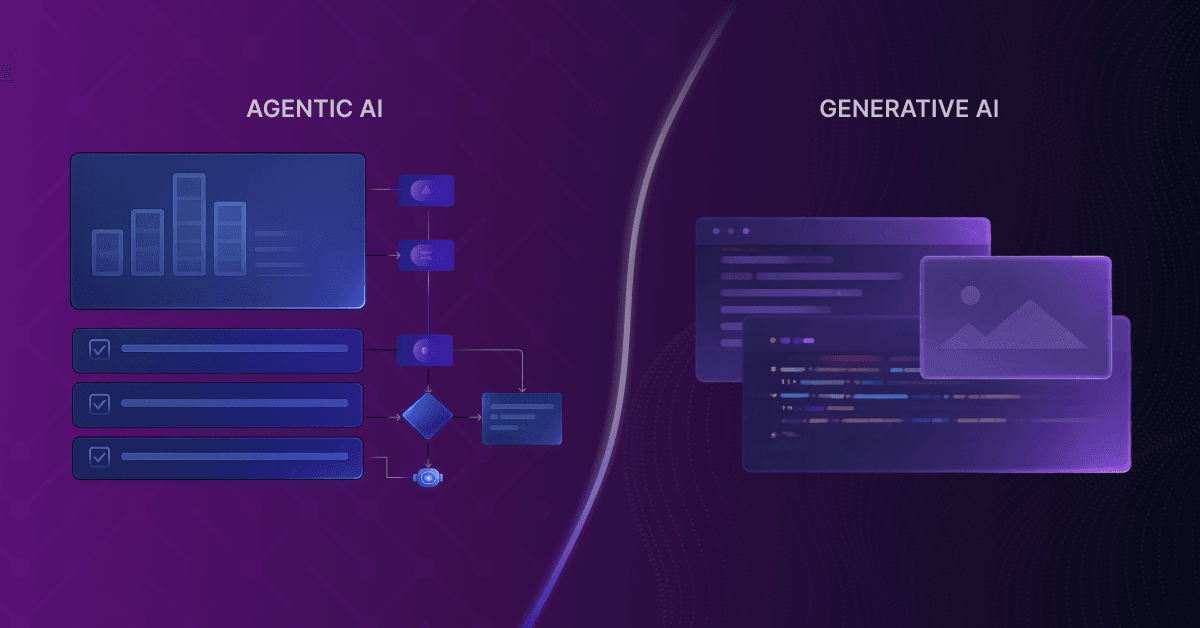
The difference between agentic AI and generative AI is no longer a debate reserved for research labs. It is a distinction that is actively reshaping how enterprises build products, hire teams, and structure work. Here is what the shift actually means — and where autonomous AI fits into your strategy.
According to Gartner, 40% of enterprise applications will embed task-specific AI agents by the end of 2026 — up from less than 5% in 2025. Organizations that delay action risk being outpaced within months, not years.
Why This Distinction Matters Right Now
Two years ago, the conversation around AI in business was still largely about outputs. Could a tool write a decent email? Summarize a meeting? Spit out a working code snippet? That version of AI felt like a smart autocomplete — impressive in demos, genuinely useful in practice, but still fundamentally reactive. You asked; it answered.
That is not the conversation happening in boardrooms today.
In 2026, the real question is about agency. Not whether AI can produce something useful, but whether it can pursue a goal, navigate a multi-step process, and deliver a completed outcome without someone holding its hand through every stage. That is the line between generative AI and agentic AI, and it is a much bigger line than it might first appear.
Understanding the difference between agentic AI and generative AI is not just useful for technologists. It is essential context for anyone making decisions about AI strategy for businesses in 2026 — whether you are building AI-powered applications, evaluating vendors, or trying to figure out where autonomous AI fits in your organization.
What Is Generative AI?
Generative AI refers to systems trained to produce content — text, images, code, audio — based on a prompt or input. The defining characteristic is that it is response-driven. A person initiates an interaction, the model generates an output, and the exchange ends there. It does not remember what happened last Tuesday. It does not follow up. It does not take an action in the world.
What generative AI does well is compression. It takes what would have been hours of drafting, coding, or designing and reduces it to minutes. That is genuine value, and it is why generative AI became so widely adopted so quickly. Marketing teams use it to go from brief to copy in a fraction of the usual time. Engineering teams use it to review code, write tests, and accelerate documentation. Operations teams use it to transform raw data into something a human can actually act on.
But the output still lands in a human's inbox. A human still decides what to do with it. Generative AI improves the efficiency of individual tasks. It does not restructure the work itself.
What Is Agentic AI?
Agentic AI starts with a goal instead of a prompt. Rather than responding to a single input and stopping, an agentic system figures out what needs to happen, sequences the necessary steps, interacts with external tools or data sources, and keeps working until the objective is reached — or until it hits a wall that requires a human decision.
How does agentic AI work, mechanically? At its core, it combines a reasoning layer — often a large language model — with the ability to take actions: querying a database, calling an API, writing to a file, sending a message, or triggering another process. It can also spawn sub-agents to handle parallel tasks, then synthesize their results. The result is a system that can handle processes that previously required a human to coordinate the individual pieces.
This is why agentic AI gets described as infrastructure rather than tooling. You do not pick it up and put it down. It runs. It has a role, a set of responsibilities, and — within defined limits — a degree of genuine autonomy.
The Core Difference Between Agentic AI and Generative AI
The most useful way to think about this is not in terms of complexity or intelligence — it is in terms of structure and scope.
| Feature | Generative AI | Agentic AI |
|---|---|---|
| Initiation | Human-driven: Human prompts; AI responds | Goal-driven: AI starts from a goal and determines next steps |
| Scope | Task-specific: Single task or output | Workflow-specific: Multi-step workflows across tools and systems |
| Memory | Transient: Limited to the conversation window | Persistent: Can persist context across sessions and actions |
| Integration | Isolated: Receives inputs, produces outputs | Connected: Reads from and writes to external systems |
| Human Involvement | High: Required at every step | Strategic: Required at boundaries, exceptions, and approvals |
| Best For | Drafting, summarizing, coding, ideation | Process automation, end-to-end workflow execution |
| Deployment Model | Tool: Picked up and put down | System Participant: Ongoing, with defined responsibilities |
Real-World Use Cases of Agentic AI
Abstract comparisons only go so far. The clearest way to understand agentic AI is to look at what it actually does in practice — and these examples show why enterprises are treating it as a strategic priority rather than a productivity experiment.
Invoice processing
Reads invoices, matches them against purchase orders, routes for approval, updates accounting systems, and flags anomalies — with no human coordination required between steps.
Customer onboarding
Collects and verifies documents, runs identity checks, sets up accounts, sends personalized communications, and escalates edge cases — in minutes, not days.
AI software development
Writes code, runs tests, interprets failures, makes corrections, and opens pull requests — compressing what used to be a multi-day cycle into hours.
Supply chain monitoring
Tracks inventory levels, identifies supply risks, generates reorder recommendations, and executes approved purchases — continuously, not on a weekly review cycle.
**Compliance reporting **
Gathers data from multiple systems, formats it against regulatory requirements, validates it, and submits reports — with a human review step before final submission.
Healthcare coordination
Manages appointment scheduling, pre-visit documentation, follow-up reminders, and referral coordination — reducing administrative load on clinical staff significantly. One early clinical AI deployment reduced documentation time by 42%, saving providers roughly 66 minutes per day.
The Benefits of Agentic AI for Enterprises
Why are organizations prioritizing this so aggressively? The short answer: the payoff profile is different from anything they have seen before with traditional automation or even generative AI.
Operational leverage at scale: Instead of accelerating individual tasks, agentic systems connect tasks into workflows. A process that once required four handoffs and three different people can become a single orchestrated flow.
Continuous execution: Unlike humans, agentic systems do not need to pick things back up after a meeting or a timezone change. Work happens when conditions are right, not when someone is available to trigger it.
Reduction in coordination costs: A significant portion of organizational overhead exists to manage handoffs — emails, status checks, follow-ups. Agentic AI can absorb much of that coordination layer.
AI-Native Solutions from the ground up: Organizations building on agentic infrastructure are not just bolting AI onto existing processes. They are rethinking what those processes should look like when execution is automated.
ROI that compounds: Organizations report average returns of 171% from agentic deployments. That figure reflects the compounding effect of removing friction across interconnected workflows, not just optimizing individual tasks.
Where Generative AI Still Dominates
Despite the momentum around agentic systems, it is worth being clear about what generative AI continues to do exceptionally well — because it is not going anywhere. In fact, most agentic systems depend on generative models to handle specific tasks within their broader workflows. An agent managing a procurement process might use a generative model to draft a vendor communication or interpret an unstructured contract. The agent provides the direction and orchestration; the generative model provides the expression.
For teams that need to move faster within their existing structure — writing, coding, summarizing, analyzing — generative AI is still the right tool. It is quick to deploy, requires minimal integration overhead, and delivers immediate gains. The case for starting there is still solid, especially for smaller organizations or those earlier in their AI development journey.
The hybrid reality: The most effective enterprise AI implementations in 2026 do not choose between generative and agentic. They combine them — using agentic frameworks to orchestrate complex workflows while relying on generative models to handle the communication, interpretation, and content-creation steps within those workflows. Together, they form a class of AI-Native Solutions that neither could power alone.
The Hidden Challenges in Agentic AI Adoption
There is a real reason Gartner also flagged that over 40% of agentic AI projects are at risk of cancellation by 2027. The technology works. The organizational readiness often does not.
Trust and observability
When a system is taking actions autonomously, the question shifts from "is the output correct?" to "was the decision appropriate?" That is a harder question to answer, and it requires visibility into the reasoning behind actions — not just the actions themselves. Organizations that treat agentic AI as a black box will hit problems quickly.
Integration depth
Agentic systems do not work in isolation. They need access to live data, real systems, and actual tools. Without that connectivity, the autonomy becomes meaningless. This is where AI software development teams and IT infrastructure become critical enablers or blockers.
Accountability clarity
If an agentic system makes a decision that leads to an error — routes a payment incorrectly, misclassifies a document, or sends the wrong communication — someone has to own that. Defining accountability before deployment is not bureaucratic. It is what makes scaling these systems sustainable.
Governance gaps
Only 21% of companies are projected to have mature AI governance frameworks by 2028. Autonomous AI without governance is not just a compliance risk — it is an operational one. The organizations seeing the best results build oversight into the architecture, not as an afterthought.
Building an AI Strategy for Businesses in 2026
The most common mistake businesses make with agentic AI is the same mistake they made with cloud migration a decade ago: trying to do too much at once, without the foundations in place.
The organizations getting this right are following a more deliberate path. They start by identifying a single workflow — ideally one with clear inputs, predictable steps, and measurable outcomes — and deploy an agentic system there. They define the boundaries of autonomy carefully. They build in human checkpoints for anything that has downstream consequences. And they treat the first deployment as a learning exercise as much as a business initiative.
What to prioritize if you are starting now:
-
Map your highest-friction, multi-step workflows — those are the prime candidates for agentic automation, not the tasks generative AI already handles well.
-
Audit your data infrastructure. Agentic systems are only as good as the data they can access and act on.
-
Define governance before deployment, not after. Decide who reviews exceptions, what triggers a human escalation, and how you will audit the system's decisions.
-
Build team literacy around AI workflows — not everyone needs to understand the technical architecture, but people whose work will be affected need to understand what the system does and does not do.
-
Resist the temptation to measure only speed. Track accuracy, exception rates, and downstream quality — those tell you whether the system is actually trustworthy at scale.
How Agentic AI Redefines Team Management
One thing that rarely gets enough attention in discussions about AI strategy for businesses is what it does to management. Leaders have always managed people and processes. Agentic AI introduces a third category: systems that act with a degree of autonomy and need to be overseen, not just configured.
That requires different instincts. You cannot manage an agentic system the way you manage a team member — through relationships, feedback loops, and judgment calls. But you also cannot manage it the way you manage a piece of software — by setting it up once and walking away. It is something in between: a participant that needs defined responsibilities, clear boundaries, and regular review.
As more execution moves into autonomous AI, human roles naturally evolve toward design, supervision, and exception handling. That is not a diminishment of human work — it is a redefinition. But it requires organizations to think deliberately about what their people should be doing as AI workflows absorb more of the operational layer.
Looking Ahead: The Competitive Divide Is Opening Now
The trajectory here mirrors what happened with other foundational technology shifts. Tools come first, systems come later. We saw it with enterprise software in the 1990s, cloud infrastructure in the 2000s, and mobile in the 2010s. In each case, early movers who built operational capability — not just access — created advantages that were difficult for laggards to close.
Agentic AI is following the same pattern, but faster. The gap between the 79% of organizations that have adopted AI agents in some form and the 11% running them in full production is the defining strategic challenge of the moment. That gap is the opportunity — and the risk.
The advantage in the next few years will not come from having access to autonomous AI. It will come from how deeply those systems are integrated into how work actually gets done — and how well the humans running those organizations can oversee and improve them over time.
Frequently Asked Questions
What is the simplest way to understand the difference between agentic AI and generative AI?
Generative AI produces outputs when you ask for them. Agentic AI pursues goals. You give it an objective, and it figures out the steps, takes actions across systems, and works toward a completed outcome — with minimal intervention in between. The difference is the gap between a tool you use and a system that works.
How does agentic AI work in practice?
At its core, an agentic AI system combines a reasoning model with the ability to take real actions — querying databases, calling APIs, sending messages, writing to files, triggering other systems. It can break a goal into sub-tasks, execute them in the right order, interpret the results, and adapt if something does not go as planned. Many enterprise implementations also include human approval steps for decisions above a certain threshold.
What are real-world use cases of agentic AI businesses are deploying today?
The most active early deployments are in finance (invoice processing, fraud detection, compliance reporting), customer operations (onboarding, support escalation, outreach), software development (code generation, testing, deployment pipelines), and supply chain (monitoring, forecasting, procurement). Healthcare is also moving quickly, particularly in administrative coordination and clinical documentation.
Does agentic AI replace human workers?
Not wholesale — but it does reshape roles. As agentic systems absorb more of the execution layer, human roles naturally shift toward designing those systems, supervising their performance, and handling exceptions and edge cases that require judgment the system cannot reliably exercise. It is less about replacement and more about redefinition of where human effort is highest-value.
Where should a business start with agentic AI?
Start narrow. Identify a workflow that has clear inputs, well-defined steps, and measurable outcomes — something where success is easy to verify. Deploy there, build the oversight infrastructure, and learn from the first cycle before expanding. The organizations struggling are usually the ones trying to automate everything at once without having proven the governance model on a smaller scale first.
Is generative AI becoming less important as agentic AI grows?
No. Generative AI remains essential — both as a standalone productivity tool and as a component inside agentic systems. Most agentic AI examples in enterprise settings involve generative models handling the communication, interpretation, and content-creation tasks within a broader automated workflow. The two are complementary, not competing.