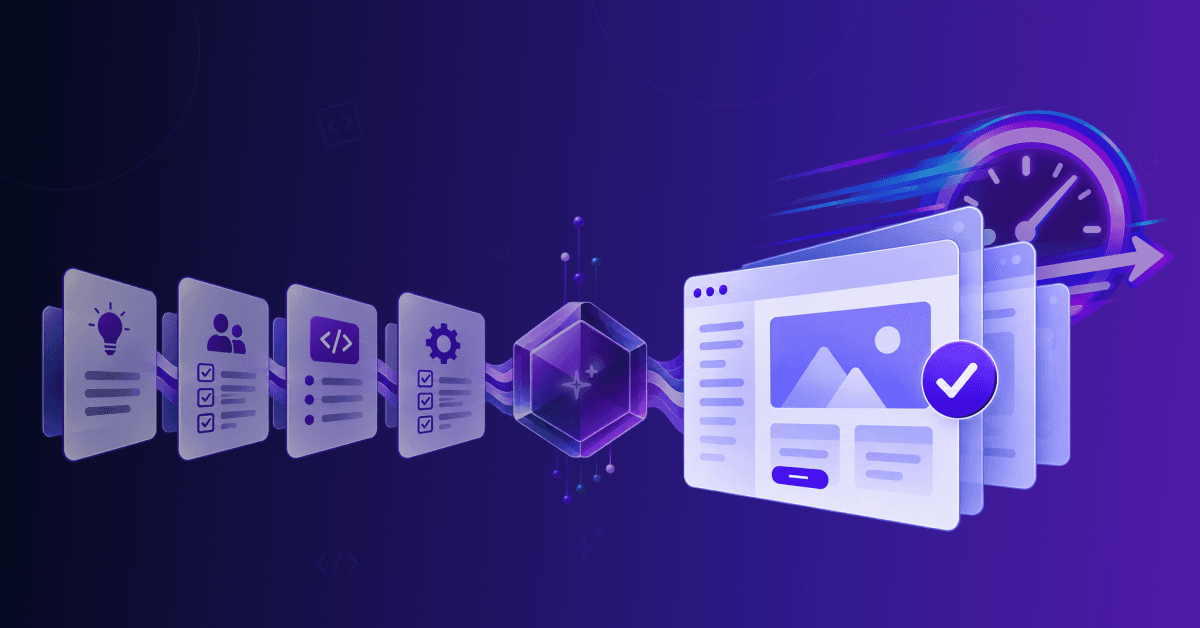
Most product teams now have AI coding tools, and code gets written faster. For many of those teams, release dates haven't moved much. AI-native product engineering is an approach that builds AI into the whole delivery process, from requirements and specs through testing and review. The aim is to shorten the stages that usually hold a release back, and those are rarely the hours spent writing code.
In this article we cover why coding assistants on their own seldom change a release date, how AI product engineering works when it's organized around specs and AI coding agents, and how Expeed uses the approach in practice.
What Is AI-Native Product Engineering?
AI-native product engineering means building software products with AI agents involved at every stage of delivery, using a written specification as the source of truth instead of the code.
Traditional software product engineering processes were designed for people doing each step by hand. When AI tools arrived, most teams added them on top, mainly to help individual developers write code faster. An AI-native team plans for agents from the beginning. Requirements are written in a form an agent can act on, tests are defined before any code is written, and quality checks are set up to catch the mistakes generated code tends to make.
AI-Native vs. AI-Assisted Product Engineering: What's the Difference?
An AI-assisted team uses AI tools inside the process it already had. An AI-native team rebuilds the process around them.
Bain & Company's 2025 Technology Report found that teams using AI coding assistants typically see productivity gains of 10 to 15 percent. Bain also found that writing and testing code take up only about 25 to 35 percent of the time between an idea and a product launch, so faster coding can only do so much if requirements, review and release stay slow. Some companies told Bain they saw gains of 25 to 30 percent after pairing AI with changes across the whole process. These numbers come from Bain's surveys of development teams and from what companies reported, so they show a direction rather than a promise.
| Dimension | AI-assisted | AI-native |
|---|---|---|
| Where AI is used | Code completion and chat in the IDE | Requirements, specs, code, tests, review and documentation |
| Source of truth | The code, plus tickets and chat threads | A versioned specification that code and tests are built from |
| What the engineer does | Writes most of the code and accepts suggestions | Owns intent and architecture, and reviews agent output |
| What usually improves | How fast individual tasks get done | Lead time from idea to release |
How Does AI-Native Engineering Reduce Time-to-Market?
It mainly works by finding expensive problems earlier. If a requirement is misunderstood and someone spots it during spec review, fixing it takes a short conversation. If nobody notices until user acceptance testing, the team has to redesign the feature, rewrite code and test again. Expeed's process is built to catch those problems early, through five practices.
1. Start every feature with a structured spec
Expeed's spec-driven development framework breaks a feature into five kinds of specification:
Intent spec: the business objective and expected outcome. Behavior spec: how the system should behave across workflows, scenarios and edge cases. Interface spec: APIs, integrations and data exchange formats. Domain spec: business rules, data models and operational constraints. Experience spec: user interactions, usability and accessibility standards.
AI writes the first draft of these specs from a short description of what the feature is for. A person then reviews the draft, adds context the AI didn't have and signs off.
2. Write tests from the spec before any code exists
Every acceptance criterion in the behavior spec turns into at least one test case. The tests describe how the feature should behave, so they don't depend on how the code ends up being written, and QA can begin on the first day of the project. Expeed has also written about turning plain-English test scenarios into Playwright tests with GitHub Copilot and Playwright MCP.
3. Give AI coding agents small, clearly bounded tasks
Once the spec is approved, AI coding agents work on one small task at a time. They follow a set of project rules that cover the tech stack, architecture, naming and security.
4. Check generated code before anyone reviews it
Veracode's 2025 GenAI Code Security Report tested more than 100 models on 80 coding tasks picked because they were prone to security flaws. In 45 percent of cases, the generated code included vulnerabilities from the OWASP Top 10. Since the tasks were chosen to be risky, the result doesn't describe all AI-written code, but it's a good reason to run automated security scans and spec-based tests before a person looks at the code.
5. Fix the spec when the code surprises you
Sometimes generated code does something nobody expected. The first thing to check is whether the spec said anything about that situation. If it didn't, the team adds the missing detail to the spec and regenerates the code instead of patching it by hand.
What Is Spec-Driven Development and Why Does It Matter?
Each practice above depends on writing decisions down before any code exists. Spec-driven development is the practice of keeping that record as the source of truth. It matters a great deal in AI product engineering, because an agent can only be as reliable as the instructions it gets. A vague prompt leads to code that looks reasonable and does the wrong thing. A reviewed spec means the agent, the testers and the reviewers all work from the same definition of done.
Here we've looked at spec-driven development mainly in terms of delivery speed. Expeed CEO Rao Chejarla covers the method itself in more depth, including why specs become a long-term asset and how engineering roles shift around them, in Spec Driven Development: The Methodology That Will Reshape How Software Is Built.
How to Start: A Practical Roadmap for the Product Teams
1. Measure current lead time
Write down how long a feature currently takes to get from approved idea to production, along with your deployment frequency and change failure rate.
2. Choose one pilot
Pick a new product, an MVP or a self-contained module that has a real deadline. Bain also recommends leaving fragile legacy systems until later.
3. Write the first spec
Write intent and behavior specs for the first few features in the pilot. If you work in a regulated industry such as healthcare or financial services, include the compliance requirements from the start.
4. Set agent rules
Agree on the tech stack, architecture patterns, naming conventions, security standards and review process that every agent has to follow.
5. Compare results
When the pilot ends, compare lead time, deployment frequency and change failure rate with the numbers you recorded at the start. Extend the approach to other teams only if the comparison supports it.
Why Choose a Custom-Build AI-Native Partner?
Buying licenses for AI coding agents is simple. Setting up the process around them takes more work, because someone has to decide how specs get written and reviewed, which rules the agents follow, how generated code gets tested and who signs off on what. When you evaluate a software product engineering partner, check what their process leaves behind in your repository.
With Expeed's approach, each feature leaves four things in the repository:
-
A spec in five parts, covering intent, behavior, interfaces, domain rules and experience.
-
A set of tests built from the spec's acceptance criteria, which don't depend on how the code is written.
-
The project rules the AI coding agents followed.
-
The code, which can be reviewed or regenerated using the same spec and tests.
When a requirement changes, the team edits the spec first, so the written record stays in step with the product. Expeed's AI-Native Engineering Playbook for 2026 explains the approach in more detail.
If you're planning a new product or trying to recover a delayed release, talk to Expeed about your project.
Conclusion
AI product engineering is worth the effort when it shortens the time between approving an idea and shipping a release you can rely on. Teams get there by recording decisions in specs, building tests from those specs and keeping AI coding agents inside clear rules. If you'd like to try it, Expeed's custom software development team can start with a single pilot.
FAQs
What is AI-native product engineering?
AI-native product engineering, sometimes called AI product engineering, is a way of building software products in which AI agents take part in every stage of delivery and a written specification serves as the source of truth. People stay responsible for intent and quality, and AI coding agents do much of the drafting, coding and test writing.
How much faster is AI-native product engineering than traditional development?
No reliable figure applies to every team, because the result depends on the product, the people and the existing codebase. Bain reports typical gains of 10 to 15 percent from coding assistants alone, and some companies report 25 to 30 percent after changing the wider process.
What is the difference between AI-native and AI-assisted development?
AI-assisted development adds AI tools to the workflow a team already has. AI-native development changes the workflow itself and organizes it around specs, tests built from those specs and AI coding agents.
Does AI-native engineering reduce software quality?
It can, if generated code goes out without proper checks. Tests built from the spec, automated security scans and a human review of every change are what keep quality stable as the volume of code goes up.
How long does it take to build an MVP using AI-native engineering?
That depends on scope, integrations, compliance needs and how quickly stakeholders agree on the spec. A narrowly scoped MVP with a clear spec moves much faster than one whose requirements keep shifting.