


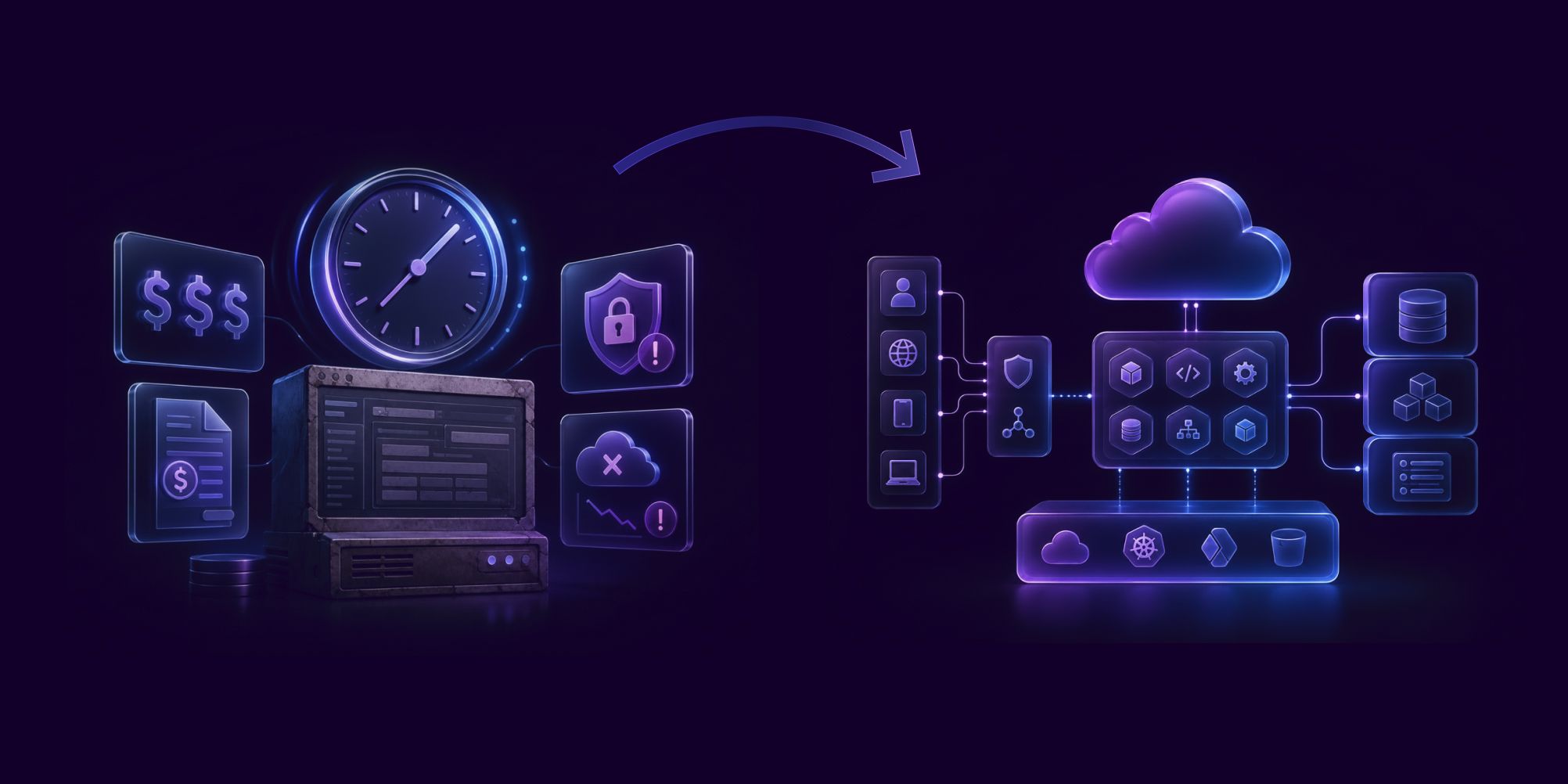
Tired of frequent bug fixes and huge maintenance costs? Losing business opportunities because you can’t scale?
Many enterprises know their legacy applications need renovation. Yet modernization often gets pushed to next quarter, next year, or the next budget cycle.
After all, if the application still works, why change it?
The problem is that the cost of delay rarely appears as a single line item on a balance sheet. It adds up quietly. The risks keep growing—more frustration for users, more maintenance efforts, more security risks.
What seems like a cost-saving decision today can become a significant financial and operational burden tomorrow.
In this blog post, we’ll explore the costs of delaying legacy application modernization and why enterprises should act sooner rather than later.
The Hidden Costs of Delaying Legacy Applications
1. Huge Maintenance Costs
Legacy applications will need frequent bug fixes. Over time, they require special support, maintenance, and manual processes. Result? You end up spending far more on maintenance than developing new software. Every dollar spent to maintain your old application is a dollar not invested in innovation.
2. Lost Business Opportunities
Legacy systems slow down your business. While you’re struggling to keep your legacy app alive, your competitors are launching new features and providing exciting user experiences. Every delayed upgrade, missed integration, or postponed idea carries a hidden cost. Over time, outdated technology makes it hard to move forward. The longer you delay modernization, the more expensive falling behind becomes.
3. Security Risks
Cybersecurity threats continue to evolve, but many legacy systems do not. Older applications run on unsupported frameworks, outdated libraries, and weak authentication mechanisms. Every unpatched vulnerability is an opportunity for attackers. Security risks of legacy applications extend beyond data breaches. A single security incident can cause significant revenue loss, compliance penalties, and damage to customer trust.
4 Business Growth Slows Down
As business expands, your customer base increases, and new opportunities emerge. But a legacy application can’t grow with your growing business needs. Expanding into new markets or supporting new processes becomes highly difficult and expensive. Instead of enabling growth, outdated technology becomes your biggest obstacle.
5. Technical Debt Grows
Newer and faster technologies emerge day by day. Just like financial debt, technical debt is the accumulated cost of outdated technology decisions that eventually require correction. When modernization is delayed, legacy code becomes harder to understand, documentation becomes outdated, dependencies become unsupported, and integration complexity increases. Eventually, even small changes require significant effort.
6. Compliance Risks
Regulatory requirements continue to evolve, but many legacy applications were not designed with today's compliance standards in mind. What met industry standards ten years ago may no longer be enough today. Audit trails can be hard to maintain. Non-compliance can lead to huge penalties, legal issues, or reputational damage. Modernization helps ensure your application supports the latest compliance requirements.
7. Integration Bottlenecks
Modern businesses depend on connected systems, APIs, cloud platforms, and real-time data exchange. Legacy applications often lack the flexibility to integrate with newer technologies. Every new integration requires manual workarounds and costly custom development. What should be a straightforward project turns into weeks of development and troubleshooting. The result? Slower innovation, fragmented data, and a business that's constantly waiting for its technology to catch up.
8. Difficult to Find Skilled People
As technologies age, it gets harder to find expert professionals to support it. Organizations running legacy applications may become dependent on a small number of employees who understand the system. When those individuals leave or retire, critical knowledge can be lost. Recruiting and retaining specialists for outdated technologies is often more expensive and challenging than hiring talent for modern platforms.
Individually, these problems may seem manageable. But all these hidden costs add up. They rarely appear on a budget line, making them easy to underestimate. So how much does delaying modernization actually cost your organization?
Estimate the Cost of Delaying Legacy Application Modernization
In this example, we use a simple method to estimate how much your business may be spending each year to maintain a legacy system. First, let’s assess the current situation of your legacy app.
| Input | Example |
|---|---|
| Number of users | 200 |
| Annual maintenance cost | $80,000 |
| Downtime hours per year | 25 |
| Number of support resources | 3 |
Now, let's calculate how much is spent each year on maintaining and supporting your legacy app.
A simple formula:
Estimated Annual Cost = Maintenance Cost + Downtime Cost + Support Cost
For example: • Annual maintenance cost: $80,000 • Downtime cost: 25 hours × $1,500/hour = $37,500 • Support resources: 3 people × $20,000 allocated support effort = $60,000
Total Annual Legacy Cost = $177,500
That's nearly $180,000 per year spent to keep an aging application running (without adding new features or driving business growth).
Next, let’s estimate the potential savings after modernization. Many organizations report 30–50% lower maintenance effort after modernization. Along with that come improved employee productivity, fewer support tickets, and reduced downtime.
If modernization reduces annual costs by just 40%: Potential Annual Savings =$177,500 × 40% Estimated Savings = $71,000 per year
Over five years, that's more than $350,000 in savings, excluding productivity gains and reduced security risks.
The question is no longer "Can we afford to modernize?". It's "How much is delaying legacy application modernization already costing us?"
The good news? Modernization doesn’t have to be a risky project. With a structured software modernization strategy, enterprises can modernize legacy applications quickly.
We recently modernized a VB6 application into .NET with cloud computing capabilities. Here’s the approach we followed.
How to Modernize VB6 Applications – a Real-World scenario
Expeed’s LegacyBridge framework is purpose-built for enterprise application modernization.
It uses a structured workflow to analyze and modernize aging applications. Here’s a Visual Basic 6 to .NET migration strategy we used:
-
Source-code analysis LegacyBridge analyzes business logic, dependencies, and technical complexities of your application.
-
Code conversion to UAST (Universal Abstract Syntax Tree) It then converts the source code to UAST, a technology-neutral representation that helps simplify the legacy app modernization.
-
Risk identification
-
Modernization-ready requirement generation Based on the findings, it suggests recommendations for target architecture.
-
Scope validation In this step, LegacyBridge estimates effort and business requirements.
-
Phased migration to modern frameworks Finally, implementing migration in phases to ensure minimal downtime.
The result? A modern, secure, scalable application ready for growth. The sooner you modernize, the faster you scale and save huge avoidable costs. So, why wait?
The Cost of Waiting Is Usually Higher Than the Cost of Acting
The longer you wait to transform your legacy application, the harder the change becomes. It quietly drains your resources. One security threat, one support ticket, one missed opportunity at a time.
Since the expenses are scattered across budgets, they’re easy to overlook. But they add up. Like most business decisions, timing matters.
The smartest organizations modernize because they understand the price of loss. Delaying modernization is like allowing your competitors to take your customers.
With decades of experience in the software industry, Expeed’s LegacyBridge is a powerful solution designed to transform legacy applications to modern technologies.
Want a personalized estimate of your software modernization strategy?
Get your free assessment and verification report
Frequently Asked Questions
Why is legacy application modernization important?
Legacy application modernization is important to better position your business in this dynamic AI era and expand your reach in global markets.
What are the risks of delaying legacy application modernization?
Delaying legacy application modernization causes high maintenance costs, low productivity, security risks, limited business growth, poor user experience, and other limitations.
What is VB6 modernization?
Visual Basic 6 modernization involves transforming applications built on VB6 to function on modern technologies without changing their core functionalities.
How long does a legacy application modernization project take?
We analyze the source code and provide a free verification report and PRD based on the issues identified in 4-5 days. Once you review and approve, it takes only 3-5 weeks.
How do you assess whether a legacy application should be modernized?
We assess based on factors like its reliability, security, business fit and value, maintenance costs, etc. of your application.