


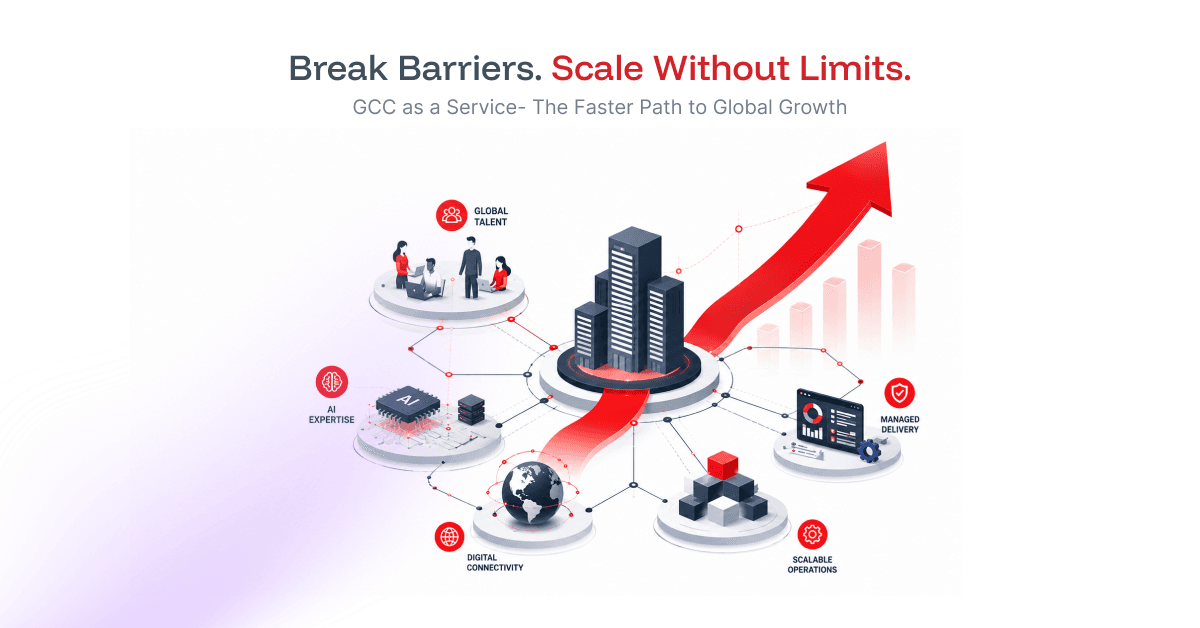
Growing a business involves many challenges. Operational hurdles, talent shortages, growing demands, competitive pressures, and so on. Companies need to scale without the complexities of building operations from scratch. That’s a reason GCCs (Global Capability Centers) have become a strategic solution for businesses around the world.
For years, GCCs were considered a way to reduce costs. But today, market demands speed. Opportunities don’t wait. Companies are looking for ways to scale globally.
In this blog post, let’s discuss how GCC as a service reshapes global operations and the innovation landscape.
Why Is GCC in Business Becoming a Competitive Advantage?
Digital transformation across industries has created huge demand for better infrastructure and specialized talent. Today, speed and flexibility matter. Here comes modern GCCs as strategic hubs that drive innovation. They provide premium infrastructure support and access to global talent across engineering, AI, data, and business operations. This accelerates product development and business growth.
As the market moves faster, a strategic GCC offers flexibility to adapt, talent to innovate, and capacity to grow. A well-structured GCC becomes your growth engine to gain a lasting competitive advantage.
And that’s where GCC-as-a-Service changes the game.
Why GCC-as-a-Service is Gaining Momentum in 2026
Today, businesses can’t wait for months or years to set up teams and infrastructure. Market demands keep growing. Companies need skilled engineers, data, and AI talents.
Here comes GCC as a Service (GCCaaS) to solve your operational challenges. Instead of spending months building infrastructure capabilities, enterprises can launch dedicated teams in weeks.
There’s no burden of setting up from scratch. In 2026, companies don’t just want to reduce costs. But to scale, improve speed and flexibility. GCCaaS helps achieve this without adding friction.
Unlike traditional outsourcing, GCCaaS offers a centre of excellence (CoE) aligned to your culture, processes, and goals while an experienced partner handles the complexities of running operations on the ground.
Once the foundation is set, the next evolution is to harness AI-powered capabilities.
How Agentic AI is Reshaping GCCs
Till recently, a global capability center was measured by its team size. But today, it’s measured by how much the team can accomplish when supported by AI.
GCCs are evolving from talent hubs to intelligence hubs. Developers are working alongside coding assistants. Operations teams use AI agents to detect incidents early. Recruiters use AI agents to support hiring through screening and interviews. QA teams use testing agents to identify defects upfront.
The shift is giving rise to the Agentic AI GCC model in which human expertise and AI agents work together to accelerate quality outcomes.
This presents a unique opportunity for companies setting up new GCCs. They can build AI-native centers from the ground up-embedding automation and AI-driven workflows into their core operations from day one.
The most successful GCCs will be the ones that best combine human expertise with the growing capabilities of AI agents.
Beyond innovation, smarter GCCs remove barriers that slow growth.
10 Ways GCC-as-a-Service Helps Companies Scale Faster
1. Faster Time-to-Market
Setting up a traditional GCC requires months of planning, hiring, and operational setup.
GCCaaS reduces that time gap. Companies need not deal with legal formalities and other setup. Instead, they can focus on higher priorities, like product development, and reach markets faster.
2. Cut down Operational Expenses
From setting up office space to deploying IT systems to handling compliance processes, establishing a GCC entails significant operational overhead. This is time-consuming and expensive.
Since GCCaaS readily offers the required operational foundation, companies can focus on building teams and delivering business outcomes. The result? A faster path to value with lower upfront investments.
3. Rapid Scalability
Growth plans are unpredictable. From a team of 20, suddenly you may need 50 specialists to support a new product launch in the next quarter. A traditional GCC comes with additional operational overhead. But GCCaaS lets you expand operations as business needs evolve. Respond faster to opportunities while keeping focus on your growth. Scale your business globally. Reach wider markets in a shorter time.
4. Full Operational Visibility
The problem with traditional outsourcing is the lack of visibility. It’s hard to track who’s working on what. Also, identifying the decision-making process and day-to-day challenges is tricky.
In GCCaaS, teams work as an extension of your organization. Hence, you gain greater transparency into delivery, performance, and day-to-day operations. GCCaaS model provides dedicated resources, direct reporting structures, and clear accountability. The result? Better alignment, faster decision-making, and more confidence in execution.
5. Stronger IP and Data Security
Protecting customer data, intellectual property, and proprietary processes are huge concerns for many organizations.
GCCaaS offers clearly defined access policies. It also supports enterprise-grade security controls. This provides you with greater control and speed.
6. Seamless Global Delivery
With GCCaaS, you implement follow-the-sun operations to support your customers 24/7. This way, key operations run smoothly around the clock. Moreover, globally distributed teams empower you to provide faster support.
7. Reduced Compliance Burden
Operating a GCC involves employment regulations, payroll administration, statutory filings, governance requirements, HR operations, and many complexities. With GCCaaS, all these processes are managed by experienced local teams, reducing operational delays and minimizing risk. As a result, business leaders can focus on growth and innovation.
8. Access to India's Deep Talent Pool
India offers one of the world’s largest talent ecosystems, producing more than 5 million tech graduates each year. GCCaaS helps tap into this talent faster through local market expertise and proven hiring practices. This helps with quicker access to specialized skills and reduced hiring time and costs.
It also helps retain talent without slowing down business momentum.
9. Clear Path to a Captive GCC
Not every company will be ready to build and operate its own GCC from day one. Enterprises can launch quickly and build high-performing teams without the upfront commitment of a captive center. As the business grows, this can transition into a Build-Operate-Transfer (BOT) arrangement. With this, enterprises can move from a managed setup to full ownership that aligns with their goals.
10. Improves Business Agility
Business requirements change quickly. New market opportunities keep emerging. Traditional setups struggle to keep pace with these changes.
GCCaaS provides flexibility to respond faster by adding capabilities and aligning to changing priorities.
Now let’s explore the difference between various operating models. This helps choose the right path for your goals.
GCC-as-a-Service vs Traditional Outsourcing vs Captive GCC
GCCaaS offers a balance between ownership and vendor convenience.
Here’s a comparison between GCC as a service, captive GCC and traditional outsourcing:
GCC as a service offers high team ownership, operational control, and IP control, whereas these are limited in traditional outsourcing.
At the same time, captive GCC offers full team ownership, IP control, and operational control.
When it comes to long-term flexibility, GCCaaS and captive GCC are highly flexible compared to traditional outsourcing.
GCCaaS and outsourcing require low initial investment and support faster setup time. But captive GCC requires high initial investment and longer setup time.
Is GCC-as-a-Service right for you?
Building a GCC from scratch involves challenges - entity setup, hiring, compliance, infrastructure etc. All these require significant time, effort, and money.
If you're looking for ways to scale your business faster without building a GCC from scratch, then, GCC as a service can be the right fit for you. This helps access specialized global talent and minimize operational risks
As business needs evolve, you can turn it into a fully owned GCC through a Build-Operate-Transfer (BOT) approach. The key is choosing a partner with expertise, AI-native solutions, local market knowledge, and operational capabilities to support your long-term goals. Expeed helps organizations launch, scale, and evolve their GCC journey in India—enabling them to focus on innovation while we handle the operational complexities.
Frequently Asked Questions
How can a company set up a GCC without establishing a legal entity?
In a GCC model, companies manage HR, operations, compliance, and payroll etc, with the help of a local partner. They need not establish their own legal entity.
What is the difference between GCC as a Service and traditional outsourcing?
Traditional outsourcing is vendor-managed hoping to meet your expectations. In contrast, GCCaaS operates as an extension of your organization, giving you greater visibility and control.
How long does it take to set up a GCC as-a-service model?
It can take a few weeks, depending on the team size and requirements.
What functions can be run through a GCC as a Service model?
Not just software development, but other functions also, such as customer support, finance, data analytics, etc can be run by GCCaaS model.
What is the Build-Operate-Transfer (BOT) model in a GCC?
A trusted partner establishes the GCC, manages the team, and daily operations in a BOT model. Ownership is transferred to enterprises once the operation is stable,
Can a mid-sized US company set up a GCC without a legal entity in India?
Yes, a mid-sized US company can establish and scale operations in India through a GCCaaS model. It need not create its own legal entity. It can still retain ownership and operational control.