
Six months. Three AI pilots. Hundreds of thousands of dollars spent. Zero measurable business impact.
Picture this: you're a CIO who signed off on three separate AI initiatives over the past year. One team built an internal chatbot. Another experimented with document summarization. A third bought a copiloting platform for customer service. Twelve months later, each project shows small, isolated wins, but none of them talk to each other, none integrate with your core systems, and none have moved a single revenue number.
This happens more often than most leaders admit. Enterprise AI projects rarely fail because the underlying models are inaccurate. They fail because the organization never built a real strategy to begin with.
Rolling out generative AI tools or one off point solutions without an enterprise blueprint is just an expensive way to accumulate technical debt. In our experience, companies don't usually struggle because they picked the wrong LLM. They struggle because they automated the wrong process in the first place.
AI is a multiplier, not a strategy on its own. What organizations actually need isn't more standalone AI tools; it's fewer tools, connected by smarter, integrated workflows backed by a solid enterprise AI strategy. A well planned AI transformation strategy ensures these initiatives are connected to measurable business outcomes.
The Enterprise Reality: Explaining the AI ROI Divide
The market narrative around artificial intelligence promises huge operational leverage. The gap between executive enthusiasm and what actually shows up in the P&L, though, is still massive. Recent enterprise research helps explain why so many implementations stall before they ever deliver value.
● The pilot purgatory trap.
According to McKinsey & Company, 88% of enterprise organizations now report using AI in at least one operational function, yet only 38% have managed to scale initiatives beyond small, localized pilots. Why the gap? Most organizations build models inside isolated innovation sandboxes. They treat AI like a bolt on software feature rather than a redesign of the underlying process, so the prototype never survives contact with legacy IT.
● The ROI disconnect.
A comprehensive enterprise survey by Gartner found that only 28% of AI projects fully meet their ROI expectations, while 20% fail outright. The biggest cost in enterprise AI usually isn't the model API bill. It's deploying the wrong use case to begin with. Poor financial performance almost always traces back to unmanaged data pipelines, runaway cloud compute costs (GPU and token usage), and no real user adoption metrics to track.
A faster process only helps if it's the right process. Technology alone doesn't drive transformation; business architecture does. An enterprise AI strategy roadmap is what connects executive vision, data readiness, and actual bottom line performance.
Is Your Organization AI-Ready?
Before anyone drafts a multi year roadmap, leadership needs an honest look at internal readiness. Trying to run advanced generative agents or predictive algorithms on top of fractured data and a culture that resists change is a good way to watch a project collapse.
Run through this checklist to spot structural gaps before you allocate capital:
● Data sanitation and access: Core operational data lives in modern cloud repositories (Snowflake, Azure, AWS) with clean metadata, few silos, and automated ETL pipelines. ● API first architecture: Existing applications (CRM, ERP, ITSM) support secure, two way API integrations so AI models can pull data and trigger actions on their own. ● C suite sponsorship: Business and technology leaders are genuinely aligned, backed by dedicated budget rather than leftover innovation funds. ● Security and privacy controls: Clear policies govern data residency, prompt security, and user permissions, so proprietary data never ends up in a public LLM's training set. ● Change management appetite: Line of business managers are actually incentivized to redesign workflows around human in the loop systems, not just treat new software as optional. ● Technical and operational skills: The organization has software engineering, data management, and cloud architecture capability, either in house or through a strategic advisory partner.
Choosing the Right AI Initiatives: The Prioritization Matrix
One of the most dangerous mistakes in enterprise AI adoption is trying to automate everything at once. A workable strategy demands ruthless prioritization based on two things: business impact and technical feasibility.
| Category | What it Means | Real-World Examples | Timeline |
|---|---|---|---|
| Fast wins | Easy to build & saves immediate money or time. | • Automated invoice parsing • Internal search over policy PDFs • Developer coding assistants | Build First: Proves AI works and generates quick ROI. Months 1–6 |
| Major Bets | Hard to build, but completely transforms your business. | • Predictive supply chain forecasting • Custom AI trained on your secret sauce/IP | Plan Now, Build Next: Start preparing data now; launch later. Months 6–12+ |
| Simple Extras | Very easy to build, but offers only minor time savings. | • AI meeting notes summarizer • Basic email auto-responders | Buy, Don't Build: Use standard tools (like Copilot); don't waste engineering time. Anytime |
| Money Pits | Very hard to build & delivers almost no real value. | • AI chatbots with no clear purpose • Replacing an entire core system with AI | Avoid Completely: Cancel these projects before spending money. Never |
1. Quick wins (high impact, low complexity): deploy first
These initiatives deliver fast ROI, build organizational confidence, and require minimal disruption to your architecture.
● Examples: automated invoice parsing, intelligent support ticket deflection, custom internal search over compliance policies, developer coding assistants.
● Action: fund these immediately in Phase 1 to prove value to stakeholders.
2. Strategic bets (high impact, high complexity): architect and plan
These are the core transformational initiatives that pay off over the long run, but they demand real data infrastructure work and process redesign first.
● Examples: predictive inventory optimization, custom retrieval augmented generation (RAG) platforms for proprietary domain knowledge, automated clinical or financial underwriting workflows.
● Action: start architectural preparation and data consolidation alongside your Quick Wins, not after them.
3. Operational fillers (low impact, low complexity): automate selectively
Small, incremental productivity boosts that save modest time without draining resources.
● Examples: out of the box meeting summarization tools, basic draft email generators.
● Action: adopt these through existing SaaS integrations (Microsoft 365 Copilot, for instance) instead of building anything custom.
4. Money pits (low impact, high complexity): avoid or shelve
Over engineered experiments that eat up engineering bandwidth for little financial or strategic return.
● Examples: fine tuning massive base LLMs from scratch for general internal communications, unconstrained customer chatbots with broad permission scopes.
● Action: deprioritize or cut these from your strategic plan entirely.
How to Create an AI Roadmap: 5 Practical Steps
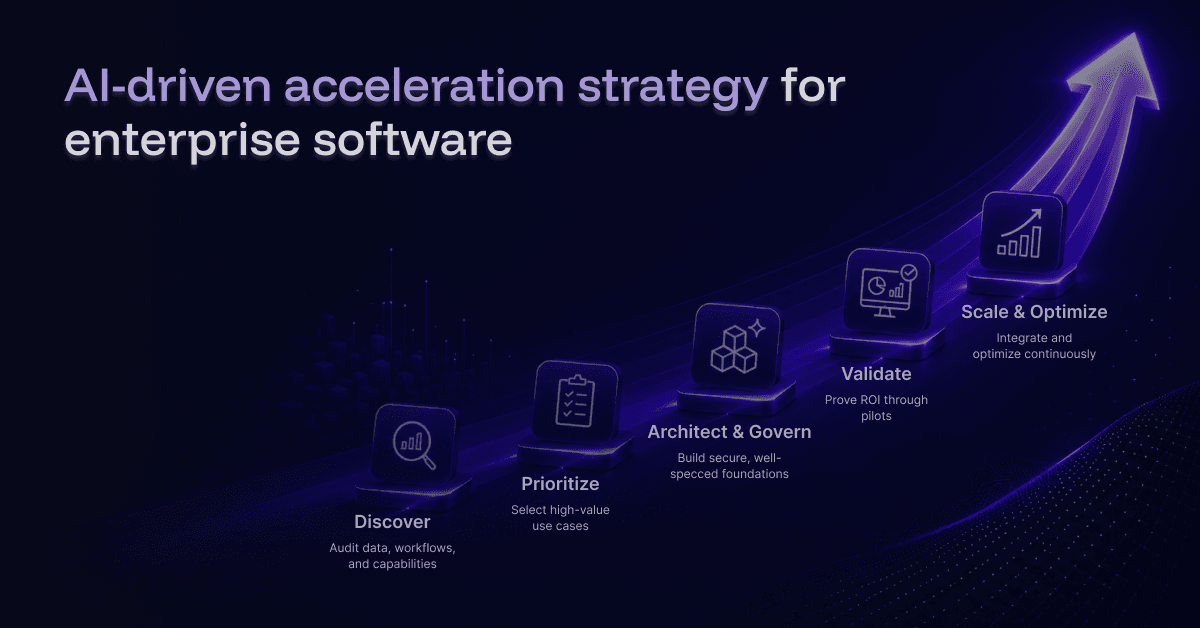
At Expeed Software, we're not fans of consulting frameworks that look great on a slide and fall apart in production. We use a straightforward, process driven execution plan to turn business vision into working software.
Phase 1: Discover and audit. Audit capabilities, data hygiene, and workflow bottlenecks.
-
Review operations across business units to find where employee hours disappear into manual data entry, unstructured text processing, or repetitive decisions.
-
Audit data readiness across every core system, checking accessibility, labeling, sanitation, and access governance.
Phase 2: Prioritize and map. Align C suite priorities and pick the use cases with the best return.
-
Plot every candidate project on the prioritization matrix, aiming for two or three Quick Wins alongside one core Strategic Bet.
-
Set exact, quantitative baselines before anyone writes a line of code (reduction in processing time per transaction, error rates, cost per service ticket).
Phase 3: Architect and govern. Build secure, scalable data architecture and infrastructure.
-
Put an enterprise AI governance framework in place, with clear guardrails around data residency, user access control, and prompt security to protect proprietary IP.
-
Design a hybrid integration architecture. Pair established commercial LLMs with proprietary enterprise data through retrieval augmented generation (RAG), which avoids the massive cost of training custom base models.
Phase 4: Validate and iterate. Deploy human in the loop pilots that actually prove ROI.
-
Build and launch targeted pilots inside a strict 60 to 90 day window, integrating directly into existing CRMs or ERPs via API rather than standing up standalone portals.
-
Bring domain experts into the validation loop to review outputs, refine prompt templates, and help train fine tuned layers.
Phase 5: Scale and optimize. Fold AI into daily workflows and manage the organizational change that comes with it.
-
Roll production systems out to additional business units, backed by real workforce upskilling and change management.
-
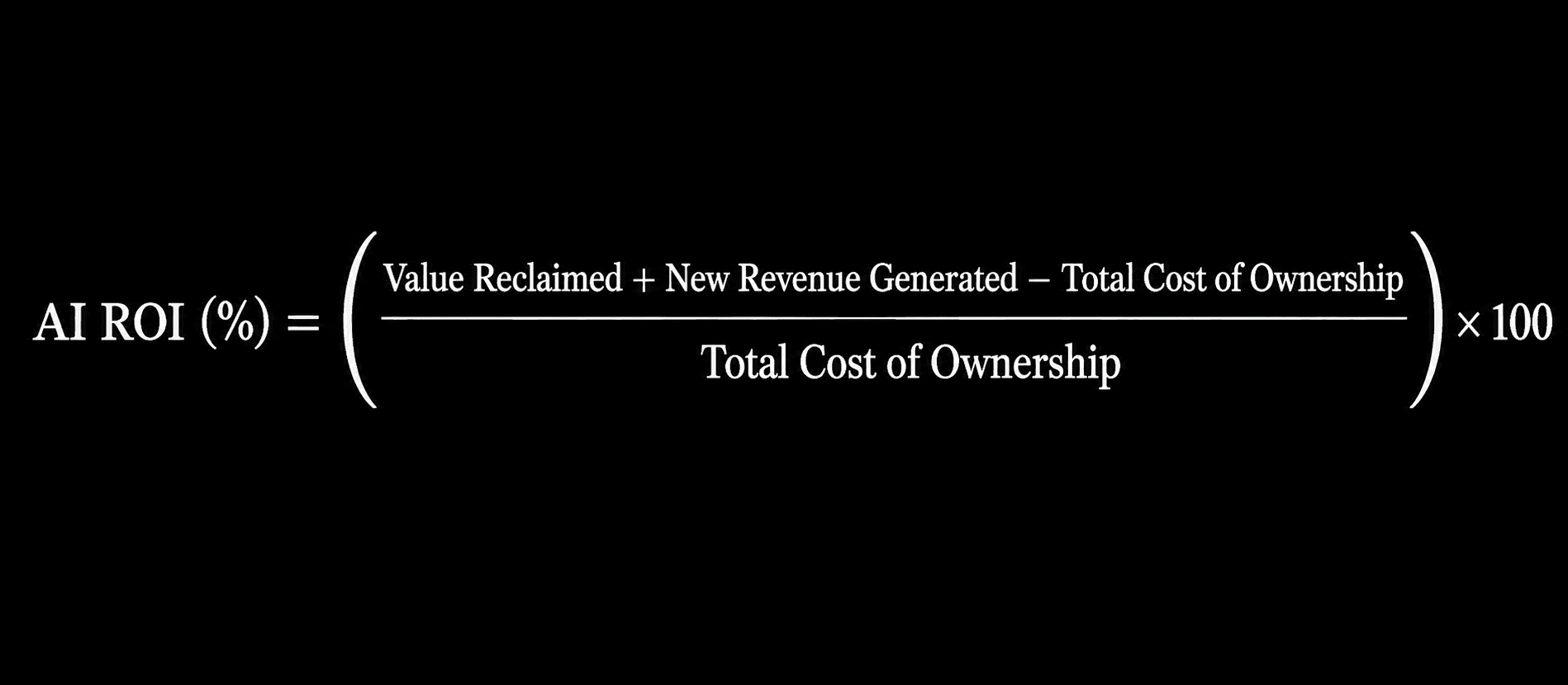
Monitor continuously (MLOps/LLMOps) to track token consumption, model drift, latency, and financial return using a core evaluation formula:
How to measure ROI of AI implementation:
Establishing an Enterprise AI Governance Framework
Once AI systems move into production, governance can't be an afterthought or a box to check for legal. An AI governance framework is an operational necessity. It protects intellectual property, secures data, and builds customer trust.
● Intellectual property protection.
Make sure every commercial vendor contract includes explicit zero data retention clauses. Proprietary enterprise data should never end up training a third party model.
● Managing shadow AI.
Banning unsanctioned tools (personal ChatGPT or Claude accounts, for instance) doesn't work. Give employees a secure, corporate sanctioned workspace with real data loss prevention guardrails instead.
● Explainability and human in the loop. For high stakes decisions, financial underwriting, healthcare diagnostic support, contract approvals, require audit logs and human expert sign off before anything executes.
5 Critical Pitfalls to Avoid in Enterprise AI Adoption
1. Building in an innovation vacuum
-
The mistake: handing AI consulting initiatives entirely to an isolated R&D lab with no input from the business side.
-
The fix: bring operational leaders onto project teams from day one, so what gets built actually solves real daily friction.
Neglecting data hygiene in pursuit of models
-
The mistake: feeding raw, unstructured, duplicate enterprise data into sophisticated models and expecting clean results.
-
The fix: put roughly half of your initial project budget toward data cleanup, integration pipelines, and metadata management.
3. Treating change management as an afterthought
-
The mistake: assuming employees will just embrace new AI tools without incentive or training.
-
The fix: explain clearly how AI removes tedious work rather than replaces people, and run real, structured upskilling.
4. Over customizing base models when RAG would do
-
The mistake: spending hundreds of thousands of dollars fine tuning or training base models from scratch for routine administrative tasks.
-
The fix: pair standard, pre trained commercial models with your proprietary internal data using retrieval augmented generation (RAG).
5. Ignoring total cost of ownership
-
The mistake: budgeting only for initial development while ignoring ongoing API token costs, vector database hosting, and continuous maintenance.
-
The fix: build a full multi year TCO model that tracks compute costs against projected efficiency gains.
Conclusion
Building a successful AI strategy roadmap isn't about deploying the latest models or automating every process overnight. It's about aligning technology investments with business priorities, strengthening data foundations, establishing governance, and scaling initiatives that deliver measurable business value.
Organizations that approach AI as a long-term business capability rather than a collection of disconnected tools are far more likely to accelerate innovation, support broader digital transformation, and achieve sustainable competitive advantage.
Whether you're just beginning your AI journey or looking to scale beyond isolated pilots, success starts with a clear strategy, measurable objectives, and disciplined execution. A well-defined enterprise AI strategy roadmap provides the foundation to prioritize the right initiatives, manage risk, maximize ROI, and ensure AI delivers lasting value across the organization.
Frequently Asked Questions
What's the difference between an AI strategy and an AI strategy roadmap?
An AI strategy sets your organization's high level vision, target business goals, and principles around artificial intelligence adoption. An enterprise AI strategy roadmap is the tactical, multi-phase execution plan underneath it: specific timelines, data pipeline projects, resource allocation, governance frameworks, and concrete KPIs.
Should every enterprise hire a Chief AI Officer?
Not necessarily. Centralized AI leadership matters, but creating a dedicated CAIO role can end up siloing technology away from the core business. Many successful companies instead put AI transformation in the hands of a cross functional steering committee made up of the CIO, CTO, Chief Data Officer, and key line of business leaders.
How long does it usually take to launch a working strategy roadmap?
Building a comprehensive strategy blueprint typically takes four to six weeks of discovery, data auditing, and use case mapping. Initial Quick Win pilots should launch within 60 to 90 days, while scaling across the enterprise is more of a 12 to 24 month, ongoing process.
How do mid market companies compete with tech giants on AI?
Mid market companies don't need a multi million dollar R&D budget or their own proprietary base model to capture real business value. By using pre trained commercial LLM APIs, cloud native vector databases, and retrieval augmented generation built on their own high value domain data, mid market businesses can move faster and often see a higher relative ROI than larger, slower moving competitors.