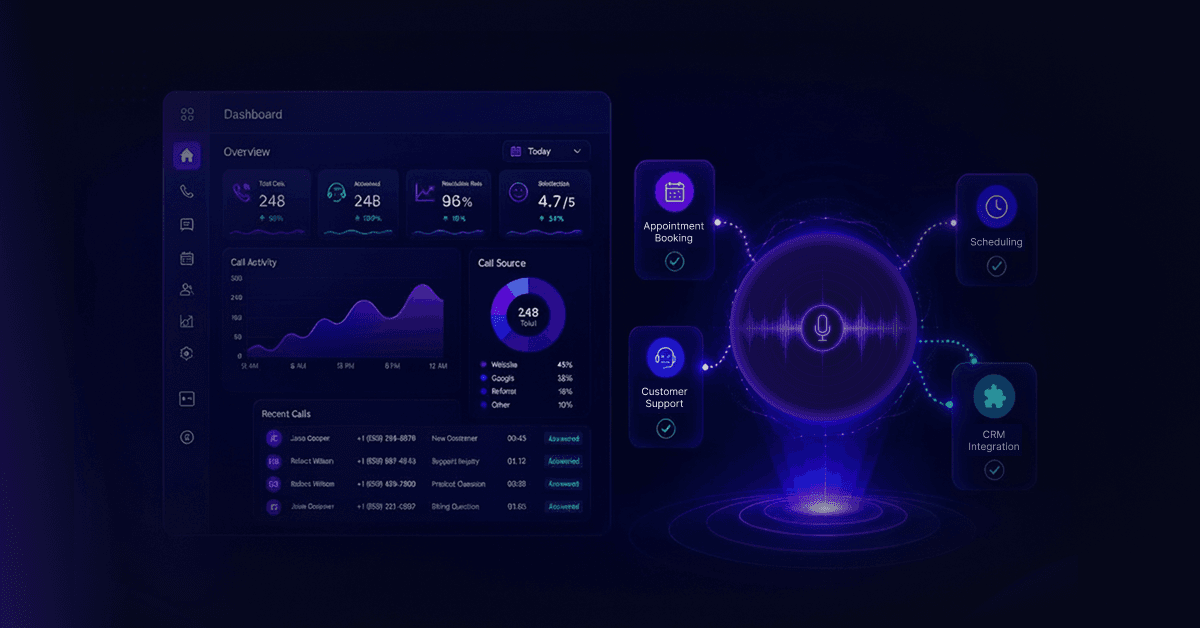
Every business owner knows the feeling. A customer calls after hours, hits voicemail, and by morning, they've already booked with a competitor. Or your front desk is juggling four calls at once during the lunch rush, and something or someone inevitably falls through the cracks.
Growing call volume is one of those problems that sounds manageable until it isn't. Hiring more staff helps, but it also means more payroll, more training cycles, and still no coverage on weekends or holidays. For many businesses, there's no clean solution but just a constant trade-off between service quality and operating expenses.
That's precisely where AI voice agents for enterprises have started earning serious attention. Not because they're a novelty, but because they've reached a point where they actually solve the problem.
Not Your Old IVR System
Many business owners hear "AI voice agent" and immediately picture those maddening automated phone trees. Press 1 for billing. Press 2 for support. Press 3 to be told you pressed the wrong number.
That's a traditional IVR system, and it operates in a fundamentally different manner. IVR is rigid by design, and it only works if callers stick to a narrow script. The moment someone asks a two-part question or veers off-menu, the whole thing collapses.
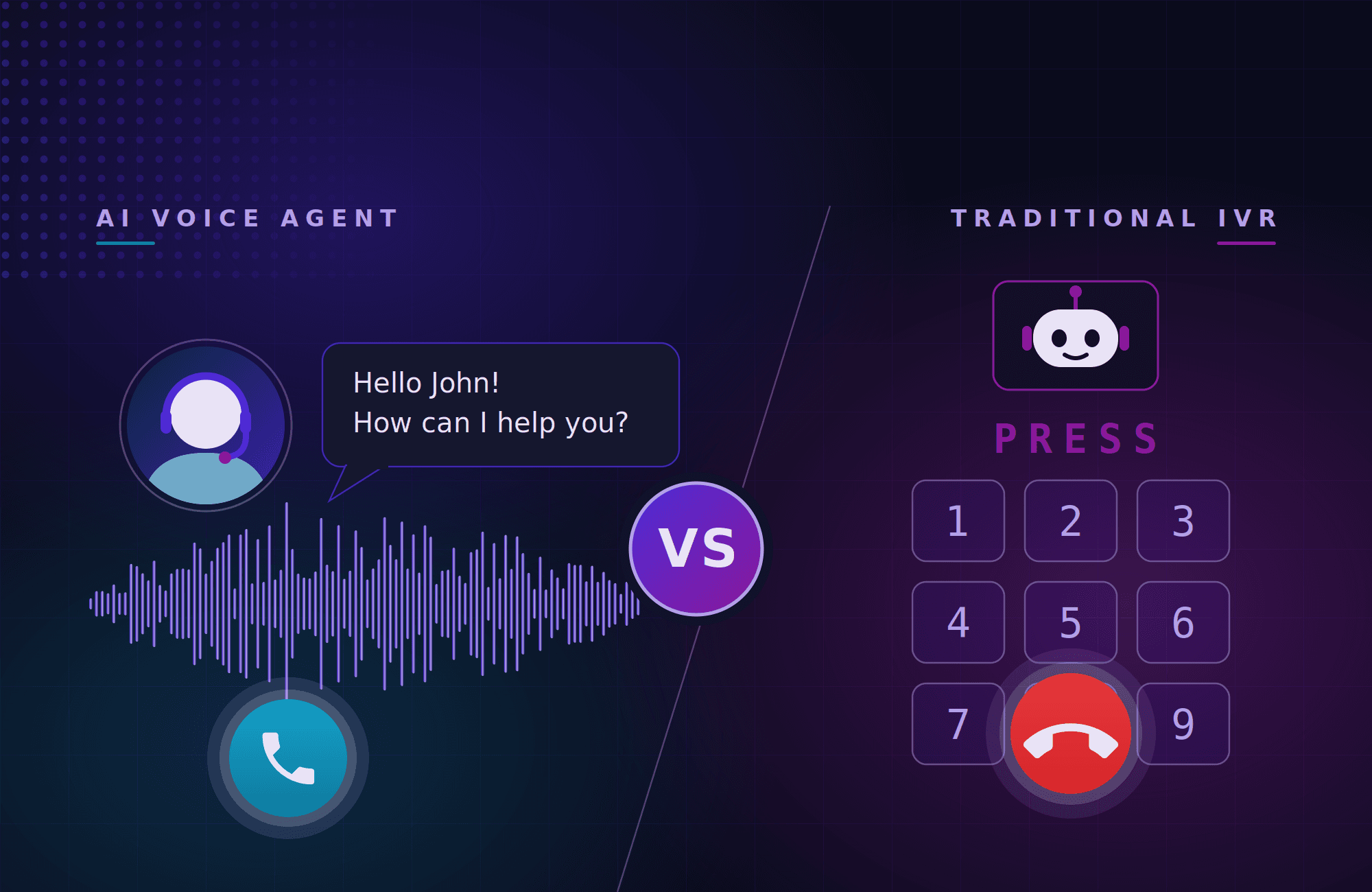
Modern AI voice agents don't operate on scripts. They're built on conversational AI that listens for intent, holds context across the whole call, and responds the way a knowledgeable person would, including when the caller interrupts, changes topics mid-sentence, or asks something unexpected. The comparison isn't really "better IVR." It's a fundamentally different approach to the problem.
Here's how the two stack up:
| Feature | Traditional IVR | AI Voice Agents |
|---|---|---|
| Customer Experience | Repetitive menus, constant friction | Natural back-and-forth conversation |
| Flexibility | Fails on anything off-script | Adapts in real time |
| Context Retention | Each call starts from scratch | Remembers details throughout the call |
| Database Access | Basic routing only | Live sync with your core business tools |
| Scalability | Limited by hardware and phone lines | Cloud-based, scales instantly |
Why do you need an ai voice agent for your business?
You probably don't need a consultant to tell you whether your current phone operation is struggling. There are some pretty clear signs:
Your team fields the same questions on repeat: If someone is answering "what are your hours?" or "how do I reschedule?" twenty times a day, that's not a staffing problem but a routing problem.
Leads go to voicemail after hours: Any call that hits voicemail at 7 PM on a Tuesday is a potential customer you've handed to whoever answers the phone.
Hold times are climbing: Long queues aren't just annoying; they're measurable damage to your customer satisfaction numbers, and callers have shorter patience than they used to.
You're considering hiring just to handle call volume: That's the moment to stop and ask whether there's a smarter alternative.
What You Actually Get Out of It
The operational upside goes beyond just answering more calls. Businesses that implement voice agents well tend to see changes across the board:
No more off-hours gaps: Customers can get real answers at 9 PM on a Sunday and not a voicemail box or a callback promise. For businesses in healthcare, hospitality, or anything with genuine urgency, this matters enormously.
Instant answers mean fewer abandoned calls: When someone gets picked up on the first ring, they stay on the line. Hold-time drop-offs disappear.
Your team focuses on work that actually requires a human: Routing a call, confirming an appointment, reading off office hours - none of that needs your best people. Voice agents handle it so your staff can focus on conversations that require judgment, empathy, or expertise.
Scale without the hiring cycle: When call volume spikes seasonally, from a marketing push, or during a crisis, a voice agent doesn't need two weeks of onboarding. It handles the surge and scales back down just as easily.
Consistency that doesn't slip under pressure: A stressed employee on their eighth hour of calls isn't going to sound the same as they did at 9 AM. An AI voice agent delivers the same tone and accuracy on call 500 as it did on call one.
Real-World Applications by Industry
Generic tools rarely hold up under the specific pressures of any given industry. The best voice agent deployments are ones where the platform is configured to match how that business actually operates.
Healthcare
Clinics use voice agents to handle appointment scheduling, send intake reminders, and field questions about hours or directions. The goal isn't to replace clinical staff, but to make sure they're not spending half their day on administrative calls that a well-designed system could handle. Compliance with patient data privacy requirements is non-negotiable here, so any healthcare deployment needs to be built with that baked in from the start.
Insurance
Volume spikes are unpredictable in insurance — a hailstorm rolls through a region and suddenly the phones are overwhelmed. Voice agents can manage initial claims intake, pull policy records on the fly to confirm coverage, and handle renewal outreach proactively. That keeps operations steady without emergency staffing scrambles.
Higher Education
Admissions offices hit the same wall every enrollment season: hundreds of students asking the same twenty questions. AI voice agents field inquiries about deadlines, application status, and campus logistics at scale, so counselors can spend their time on the conversations that genuinely need a human touch.
Travel and Hospitality
Booking changes and travel disruptions don't happen on a 9-to-5 schedule. Hotels and travel companies use voice automation for 24/7 reservation management — itinerary changes, cancellation policies, check-in questions with real-time database access and multilingual support.
Why do you need an ai voice agent for your business?
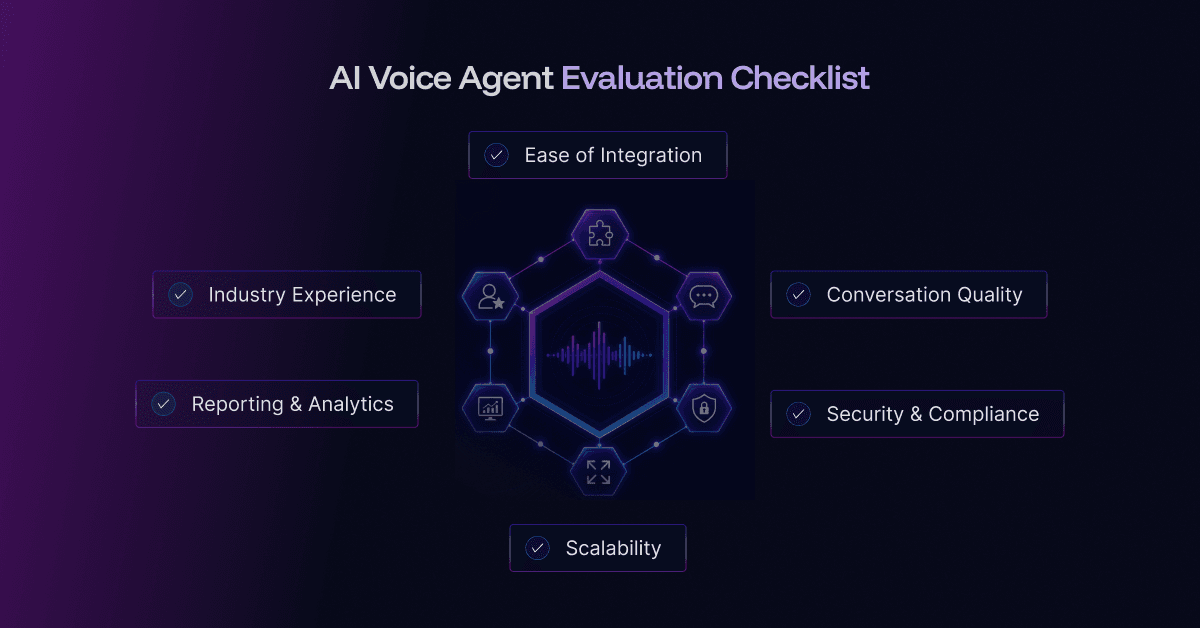
Not all AI voice agent solutions deliver the same experience. Beyond impressive demos and marketing promises, it's important to focus on the factors that will have the biggest impact on your day-to-day operations.
Ease of Integration
The platform should work with the systems you already use, whether that's a CRM, scheduling software, helpdesk platform, or customer database. The easier it integrates, the faster your team can start seeing value.
Conversation Quality
A good voice agent should sound natural, understand customer intent, and handle interruptions or follow-up questions smoothly. If conversations feel robotic or scripted, customer adoption will suffer.
Security and Compliance
Customer conversations often contain sensitive information. Look for platforms that prioritize data security and support compliance requirements relevant to your industry.
Scalability
Your needs today may be very different from your needs six months from now. Choose a solution that can handle increasing call volumes without requiring additional infrastructure or staffing.
Reporting and Insights
The right platform should do more than answer calls. It should provide visibility into customer inquiries, call outcomes, frequently asked questions, and performance trends that can help improve business operations.
Industry Experience
Every industry has unique workflows and customer expectations. A provider with experience in your sector is more likely to understand your requirements and help you achieve results faster.
When comparing vendors, focus on how effectively they solve your business challenges rather than simply comparing feature lists. The best solution is the one that fits naturally into your operations while delivering measurable improvements in customer experience and efficiency.
To help make the final call between vendors, scoring them across these six dimensions works well in practice:
| Evaluation Criteria | Priority Weight | What to Look For |
|---|---|---|
| Conversation Fluidity | 20% | Does it handle interruptions naturally, or does it feel scripted? |
| Security & Compliance | 20% | Audited SOC 2 Type II report, healthcare BAA capability |
| Integration Capabilities | 15% | Native CRM sync, automatic call logging |
| Scale & Speed | 15% | Consistent response times under peak load |
| Industry Experience | 15% | Case studies from your specific sector |
| Total Cost of Ownership | 15% | Full cost including setup, usage, and ongoing fees |
Is Your Business a Good Fit for an AI Voice Agent?
Not every business needs an AI voice agent. But if customer communication is becoming harder to manage as your business grows, it's worth taking a closer look.
You may benefit from an AI voice agent if:
- Your team spends a significant amount of time answering the same questions every day.
- Customer calls frequently go to voicemail after business hours.
- Appointment scheduling, confirmations, or follow-ups consume valuable staff time.
- Seasonal spikes in call volume create long wait times and overwhelmed teams.
- You are considering hiring additional staff primarily to manage phone inquiries.
- Customers regularly experience hold times or abandoned calls.
- You want to provide support outside normal business hours without expanding your workforce.
If several of these challenges sound familiar, an AI voice agent can help streamline routine interactions while allowing your team to focus on higher-value work that requires human expertise.
The Bottom Line
A voice agent deployment is a business infrastructure decision, not a software subscription. Done right, it closes the gaps that cost you customers, frees your team from work that doesn't require them, and gives you data you've never had before about how your customers actually communicate.
At Expeed Software, we believe that AI should be built around the way you already work. Our voice solutions are designed to be more than just a layer of tech; they are integrated components of your operational workflow, designed to scale with your business and provide the meaningful, reliable interaction your customers expect.
Frequently Asked Questions
Q1: What is the typical timeline for deploying a voice agent into our workflow?
A: If you already have an established CRM and a clear map of how your leads flow, you can expect to be live in just 5 to 7 business days. Most of this window is dedicated to refining the conversation flow and mapping out your data fields, while the actual backend technical setup usually takes less than a day. The only exceptions are highly regulated industries like healthcare platforms requiring custom BAA agreements or complex, multi-department setups, which can push the rollout to 2 to 3 weeks.
Q2: How do we handle complex customer issues that the AI can't resolve?
A: A well-implemented voice agent is designed to know its limits. When a conversation requires deep empathy, complex problem-solving, or human judgment, the AI executes a warm transfer. It routes the caller directly to a live team member and automatically passes along the transcript and context of the call so the customer doesn't have to repeat themselves.
Q3: How long does it typically take to get an AI voice agent up and running?
A: Timeline variations depend entirely on your workflows and tools. A straightforward deployment for routine tasks can take just a few weeks.
-
Out-of-the-box setups for basic FAQ routing and appointment confirmations can often be live within 2 to 3 weeks.
-
Deep enterprise integrations that require the AI to sync seamlessly across custom CRMs, electronic health records (EHRs), or complex booking databases typically take 6 to 12 weeks to fully test and deploy.