Picture asking one employee to negotiate vendor contracts, audit tax compliance, redesign the cloud infrastructure, and handle customer escalations - all in the same afternoon. Few companies would structure a job that way. Yet a lot of early generative AI deployments have followed roughly that pattern: one large model, one chat window, asked to cover far more ground than a single system can reasonably handle well.
The strain tends to show up in familiar ways. Prompts balloon, responses slow down, context gets muddled, and the whole thing stumbles the moment a task strays from a straight line. That experience has pushed a shift in how a lot of executives frame the problem. The question used to be "how can AI help someone get through a task faster?" Increasingly, it's "how do we get autonomous systems to run entire business processes safely and at scale?"
That reframing is largely what's driving interest in multi-agent AI: networks of narrower, specialized components that divide up a complex workflow and coordinate with each other, instead of one generalist system trying to do it all. Multi-agent systems aren't a new idea in computer science, but this is the first time enterprises have had the tooling — mature APIs, capable models, and real orchestration software — to run them in production rather than research.
Why This Is Gaining Traction Now
It's tempting to credit bigger, smarter language models for the shift, but that's only part of the story. Three practical developments matter just as much:
1. APIs finally matured. Enterprise systems increasingly expose stable, well-documented interfaces, so software can read and write into CRMs, ERPs, HR platforms, and databases without someone building custom integration code for every connection.
2. Coordination got more precise. Teams can now set real guardrails through an agent orchestration framework — deciding exactly where a system is allowed to act on its own and where it has to stop and check with a person first.
3. The economics improved. Running a small, purpose-built model against a narrow task is generally cheaper and faster than funneling everything through one very large model.
What the numbers suggest
Gartner projects that by the end of 2026, roughly 40% of enterprise applications will include task-specific AI agents, up from under 5% the year before. By 2027, the firm expects about a third of those deployments to involve several components working together as true multi-agent systems rather than one agent acting alone.
On the return side, Microsoft-sponsored IDC research on generative AI investment broadly (not agentic systems specifically) puts the average payback at around $3.70 for every dollar spent, with the top-performing organizations seeing considerably more.
The picture isn't uniformly rosy, though. Gartner has also forecast that a large share of agentic AI projects, on the order of 40%, will be scaled back, shelved, or scrapped by 2027, typically because costs ran ahead of expectations, the business case never firmed up, or oversight wasn't built in from the start.
Read together, these figures point to a fairly consistent conclusion: the model itself tends not to be what separates the multi-agent AI deployments that work from the ones that don't. How the system is designed and supervised usually matters more.
Why a Single AI Assistant Struggles at Scale
Many first-generation enterprise AI tools were built for narrow, one-shot tasks:
| Workflow Dimension | Single-Assistant Model | Multi-Agent Network |
|---|---|---|
| Execution Flow | Request ➔ Assistant ➔ Output | Trigger ➔ Orchestrator ➔ Parallel Sub-Agents |
| Task Handling | Linear: Sequential processing by one LLM | Concurrent: Specialized agents execute tasks simultaneously |
| Vendor Onboarding Example | One assistant attempts to review contracts, score credit, and check compliance in a single long prompt. | • Identity Agent: Runs fraud checks • Compliance Agent: Audits regulations • Finance Agent: Configures ERP & risk score |
Asking a single model to carry that entire sequence tends to create a few recurring problems:
The context gets crowded. Legal terms, vendor history, compliance rules, and ERP schemas all competing for the same window tends to reduce accuracy across the board.
Early mistakes compound. Misread one compliance clause partway through, and everything downstream is built on that bad assumption.
Auditing after the fact is painful. When a compliance officer asks why a vendor was approved, "here's a forty-page chat transcript" rarely counts as a satisfying answer.
Single-Agent vs. Multi-Agent AI: Where Each One Fits
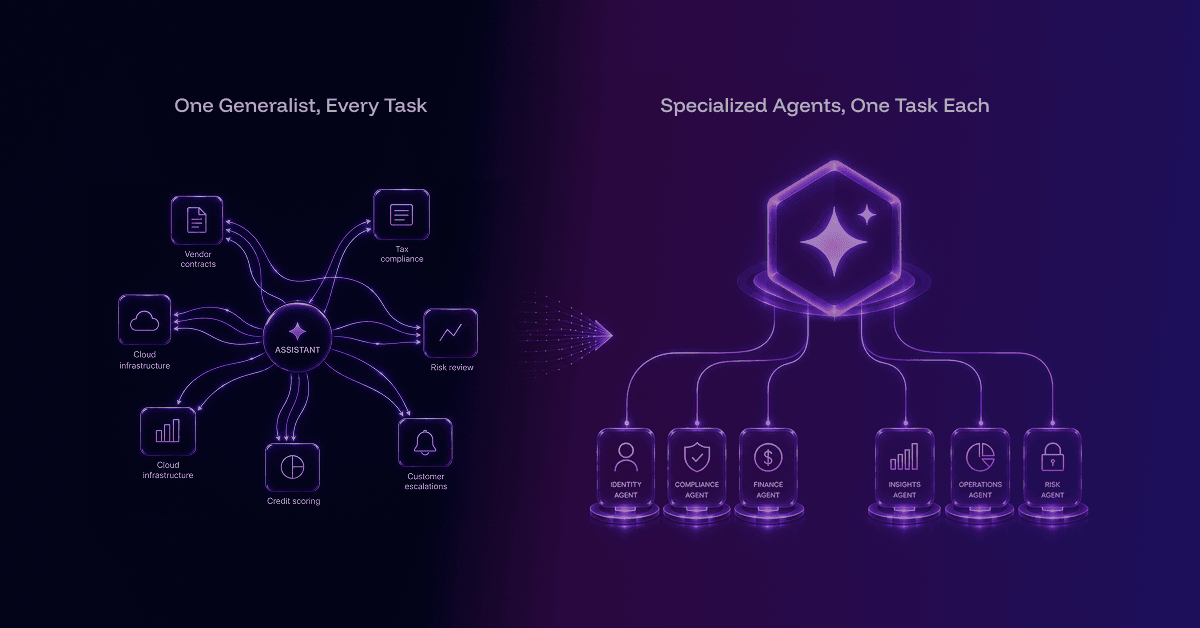
The single-agent vs. multi-agent AI question isn't really about which approach is "better" — it's about matching the architecture to the shape of the work.
| Dimension | Single-Agent AI | Multi-Agent Systems |
|---|---|---|
| Execution model | One generalist handles the whole process | Specialized agents each own a piece of it |
| Typical scope | Isolated, single-step tasks | Workflows spanning several systems |
| Context handling | One large, dense prompt | Focused context per agent |
| Failure behavior | A single point of failure | Errors tend to stay contained |
| How it scales | Move to a bigger, pricier model | Add another purpose-built agent |
| Oversight | Manually reading unstructured logs | Structured, event-based tracking |
Framed this way, single-agent vs. multi-agent AI isn't a debate to settle once — it's a decision to revisit for every workflow you're automating.
The Agent Orchestration Framework: The Part That Actually Does the Work
Adding more specialized agents on its own doesn't solve much, without something tying them together, it can make things worse. Agents can step on each other, fire off duplicate calls, or push through changes nobody approved. This is where an agent orchestration framework earns its keep. It typically covers four things:
Keeping track of where things left off If a claims validation process fails three hours in, a solid agent orchestration framework picks up from the last saved point instead of starting over from scratch.
Enforcing sequence and handoffs Agents don't act independently of each other; there are rules. A sourcing agent, for instance, shouldn't be able to cut a purchase order until a compliance agent has signed off on the vendor's paperwork.
Pausing for a human at the right moments Anything genuinely high-stakes such as approving a large credit line or pushing a major system change, gets routed to a person for sign-off before it goes further.
Resolving disagreements When two agents reach opposite conclusions, say, one confirms stock is available while another flags a shipping constraint, the orchestration framework either applies a policy rule or escalates it to someone who can decide.
Without this layer, multi-agent AI is really just several single agents running in parallel and occasionally colliding. With it, they behave like one coordinated system.
How This Plays Out in Practice
BNY Mellon.
The bank built a recommendation system, part of its internal Eliza platform, where roughly a dozen specialized agents work together: one holds detailed client information, others carry deep knowledge of specific product lines such as payments, treasury services, collateral, and so on. Rather than a salesperson tracking down ten different product specialists, the multi-agent system pulls that expertise together to suggest a fit for the client.
Oncology treatment planning.
Some healthcare networks and clinical research groups have split this process into stages: one agent pulls together patient history, labs, and imaging into a structured summary; another checks findings against staging benchmarks; a third proposes options grounded in established guidelines with a physician still making the final call.
When This Isn't the Right Fit
It's easy to get excited about multi-agent systems and reach for them everywhere. That's usually a mistake. A few situations call for something simpler:
The workflow is genuinely linear Drafting a reply or summarizing a meeting doesn't need this. A single AI assistant handles it faster and with far less overhead.
It doesn't happen very often If a process runs only a handful of times a month, building and maintaining a full agent orchestration framework for it usually costs more than it saves.
The task needs an exact, deterministic answer Payroll math and similar rules-based calculations are generally better handled by traditional software than by a probabilistic model.
A Practical Starting Point
Look for where work already stalls The handoffs between departments such as vendor onboarding, employee lifecycle changes, claims processing are usually where the payoff shows up fastest.
Fix the plumbing before worrying about model size Multi-agent AI is only as good as what it can actually connect to. Well-documented interfaces and solid access controls tend to matter more than which model sits on top.
Match oversight to how much autonomy is involved An agent that can take real-world action such as moving money or changing a system needs tighter human review. A read-only, internal-facing agent doesn't need nearly as much.
Where This Seems to Be Heading
The competitive edge in this space looks less likely to come from access to the single biggest model — those are becoming commodities fairly quickly — and more likely to come from how well the surrounding multi-agent system is designed and supervised.
Organizations that keep trying to run genuinely complex operations through one unstructured prompt tend to run into the same issues: errors, blind spots, and oversight that can't keep pace. Teams building modular, well-supervised multi-agent AI networks instead are, more often than not, the ones turning scattered manual processes into something closer to self-running, though even they still run into the governance gaps Gartner points to when the surrounding process isn't thought through.
The near-term future of enterprise software probably isn't a smarter assistant sitting in a sidebar. It looks more like a coordinated set of specialized agents doing the work in the background, in a way that can actually be reviewed and explained after the fact.
If any of this sounds like where your organization is headed, it's worth thinking through early: which processes are worth this kind of investment, how the agents should hand work to each other, and where a person needs to stay in the loop. That's the design work Expeed does with enterprise teams — architecting and building multi-agent systems and the orchestration frameworks that hold them together, around real workflows, not just standing up a chatbot. If you're weighing whether a process is a good candidate, our engineering team is a reasonable place to start that conversation.
Frequently Asked Questions
###What is a multi-agent AI system?
A multi-agent AI system is a group of specialized AI agents that each handle a distinct part of a larger task and coordinate with one another — through an agent orchestration framework — to complete workflows that would overwhelm a single generalist model, such as vendor onboarding, claims processing, or clinical treatment planning.
###How is a multi-agent system different from a single AI agent?
A single AI agent tries to carry an entire process in one context window, which works fine for a linear, one-shot task like drafting an email but tends to break down on multi-step, cross-system work. A multi-agent system splits that same work across several narrower agents, each with a focused context, connected through an orchestration layer that manages handoffs, state, and error handling. That's the core of the single-agent vs. multi-agent AI decision: match the architecture to how linear or cross-functional the work actually is.
###What industries are adopting multi-agent AI systems in 2026?
Financial services, healthcare, and insurance are among the furthest along, largely because their processes — vendor and client onboarding, treatment planning, claims validation — naturally span multiple specialized domains and systems of record. Gartner's research suggests broader adoption across enterprise software generally, with roughly 40% of enterprise applications expected to include task-specific agents by the end of 2026.
###What are the biggest risks of deploying multi-agent AI in the enterprise?
The most common failure points are unmanaged execution costs, unclear business value, and governance gaps — the same issues Gartner cites in forecasting that a large share of agentic AI projects will be scaled back or canceled by 2027. Multi-agent systems deployed without a real agent orchestration framework are also prone to conflicting decisions, duplicate actions, and audit trails that are difficult to reconstruct after the fact.
###How do AI agents communicate and coordinate with each other?
In most production systems, agents don't message each other freely — they operate through an agent orchestration framework that defines the sequence of handoffs, persists state between steps, routes high-stakes decisions to a human for approval, and resolves conflicting outputs from different agents, either through predefined policy rules or by escalating the disagreement to a person.